By Amanda King, Lead Service Designer at Nimble Approach
Nimble recently attended the GDS Local Early Years Innovation Day, hosted by Government Digital Service, National Data Library, Local Government Association, South Yorkshire Mayoral Combined Authority, and Sheffield Hallam University.
The event brought together people from across the early years ecosystem – from health visitors and early years practitioners to policy makers, data specialists, technical architects and designers – to explore a series of challenges.

Many perspectives, one shared challenge
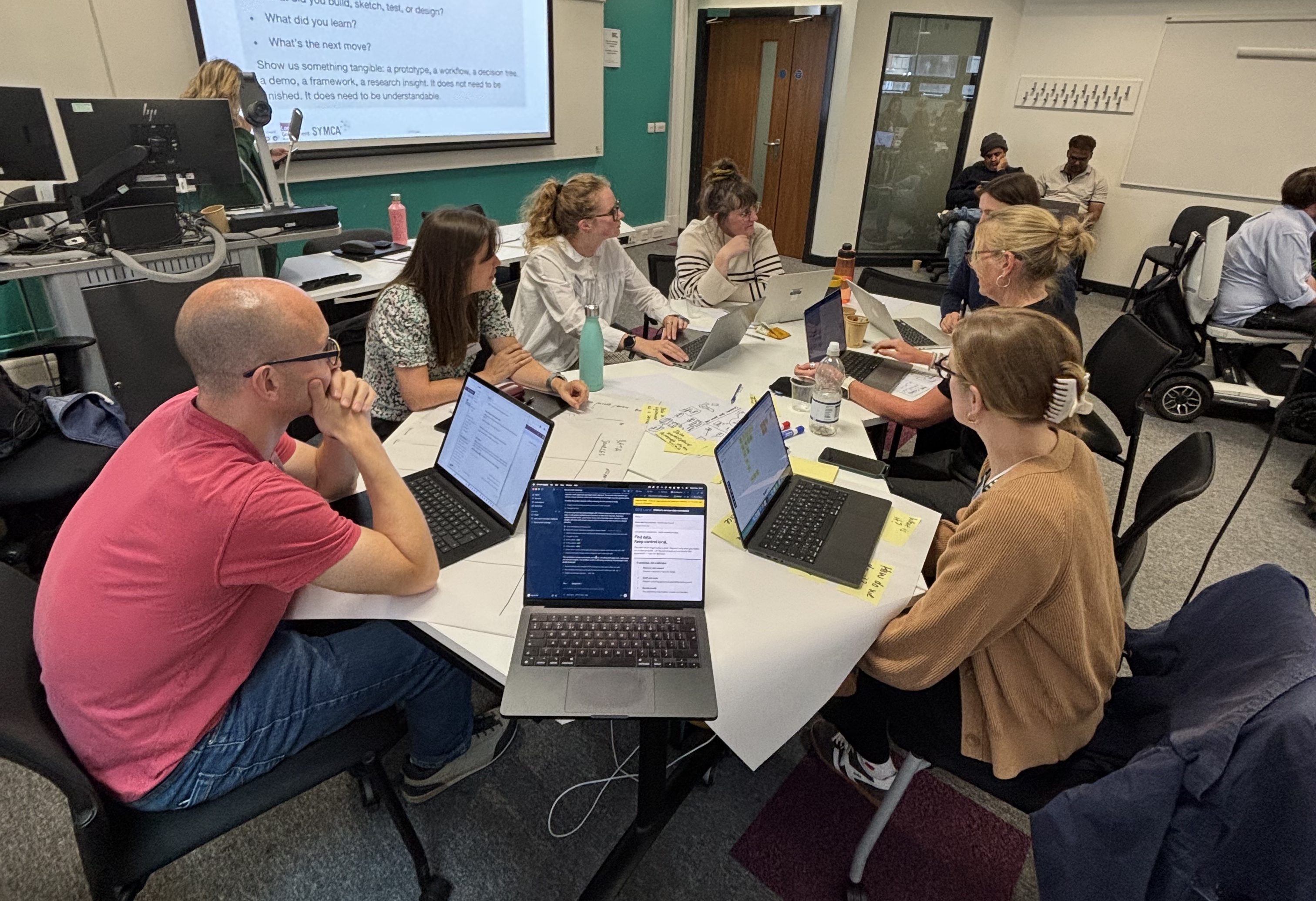
The day was facilitated by colleagues from GDS and organised around 11 multidisciplinary squads, with around 10 people in each. We were grouped according to our preferred challenges, bringing together people with very different perspectives and experiences.
To us, that mix was one of the most valuable parts of the day, echoed by Phil Swan, Director of Government Digital Enablement at GDS:
“It’s great to see some of the creative tension between different perspectives and teams – users, technology, information governance. It is that coming together of different perspectives that just generates some of the most amazing ideas.”

The morning was about understanding the challenge, getting to know the people in our squad, and generating ideas. We used the Crazy 4s exercise to rapidly get ideas down on paper before sharing, discussing, and voting on which concept we wanted to take forward.
It was a great example of divergent thinking in practice: starting with lots of individual ideas and, in a relatively short space of time, moving towards a shared direction.
Then came the afternoon – and the clock was ticking.
We had just two hours to develop our idea further. We worked through the problem statement, identified our users, and explored what a potential solution could look like before creating a prototype. We then presented our ideas back to our challenge groups, with the strongest three concepts progressing to a final presentation in front of a panel of judges and the wider event.
Challenge statement
“How might we reduce the need for local services to solve the same information-sharing problems repeatedly, while preserving the flexibility needed to meet local needs?”
Problem statement
Local authorities often lack visibility of what early years data other organisations hold, what can be shared, and where effective approaches already exist. This makes it harder to access and share data, slows the development of data-sharing agreements, and limits opportunities to learn and reuse what works.
Solution
We proposed a ‘data marketplace’ framework called Weave, for early years data, bringing together and building on approaches that local authorities are already developing. Co-designed with local authorities, the framework would provide common standards, reusable patterns, and shared learning, while allowing for local adaptation. This would make it easier to discover and access data, share effective approaches, and reuse what works across different early years regions.
The framework would improve access to data for those delivering services and support better outcomes for children and families.

The question of data
One thing that quickly became clear was just how central data was to the conversations.
Whether we were discussing challenges faced by practitioners or thinking about what future services might look like, we repeatedly came back to questions about how information is collected, connected, accessed, and shared across organisations.
What initially appeared to be service or operational problems often had underlying challenges around data sharing, accessibility, ownership, or interoperability.
But the day also reinforced that data isn’t the solution in itself.
Better data needs to be combined with better services, processes, and relationships. Understanding who needs information, why they need it, how they currently work and what barriers they face is just as important as understanding the technology or infrastructure behind the data.
That feels like an important role for service design: connecting the dots between user needs, organisational challenges, policy, data, and technology.
What multidisciplinary working made possible
The diversity of perspectives made for some particularly useful discussions. Practitioners, policy makers, analysts, technical architects, and designers could challenge ideas from very different angles, helping teams see problems they might otherwise have missed.
The speed of the process was striking too. Moving from a broad challenge to a problem statement, users, and a prototype in a single day demonstrated what multidisciplinary teams can achieve when they have a clear focus and limited time.
There was also a strong tension between national consistency and local needs. It was recognised that common approaches could reduce duplication, while local services still need the flexibility to respond to their particular circumstances.
That led to another important takeaway: there is significant potential to reuse existing good practice. Local areas are often tackling similar problems independently, creating opportunities for shared standards, patterns, and approaches rather than repeatedly solving the same problems in different places.

Why problem framing matters
Perhaps the biggest lesson from the day was the importance of stepping back from the solution.
The strongest discussions came when we focused on the underlying user and service problem rather than jumping straight into what we could build. That can be particularly important when talking about data. Data-sharing challenges can easily be framed as technical problems, but understanding the people, services, and organisations around that data is essential if we’re going to design solutions that actually work in practice.
The day was a useful reminder that complex early years challenges need multidisciplinary solutions. No single profession or organisation has the full picture.
What we’re taking forward
For us, one of the biggest takeaways was the value of bringing service design into conversations about data.
Unlocking better outcomes from data is more than just an interface/access challenge. It’s a human centered design challenge. Technology in isolation is not a silver bullet. You need wider capability and expertise wrapped around to build functioning user centered services underpinned by data.
We’ve seen this first hand across our work at the Department for Education. To improve access to the National Pupil Database (NPD), a complex ecosystem containing 22 million sensitive pupil records, we led user research and service design from Discovery to Beta. By balancing user needs with policy intent, we proved that data access relies on designing intuitive processes, ultimately delivering an 80 percent reduction in time to access data and significantly cutting support costs. Nimble supported DFE Regional Services Division through a data estate modernisation, replacing a legacy T SQL platform with a federated Databricks Data Lakehouse. Incorporating Unity Catalog, Medallion architecture, PySpark, and automated pipeline checks, this technical overhaul eliminated duplicate effort, enforced robust governance, and established an AI-ready data foundation. Together, these projects highlight how combining user-centric service design with modern Databricks architecture empowers organisations to turn fragmented data into fast, reliable, and decision-ready insight.
The day also reinforced the wider value of creating reusable approaches rather than repeatedly solving the same problems locally – something that feels particularly relevant to the conversation around service patterns, standards, and improving information sharing across public services.
A single day can’t solve the complexity of early years data and services. But bringing the right mix of people together, creating space to properly frame the problem, and giving teams the time and structure to explore ideas can be a powerful way to start.