By Nina Midgley, Head of Public Sector at Nimble Approach
As a partner to the public sector, Nimble Approach works alongside civil servants to deliver real impact for citizens. This often means navigating silos, fragmented data, and rigid governance structures.
After over a decade of delivering GDS-compliant digital outcomes, I’ve felt these pain points firsthand. I’ve participated in endless conversations about “build once, use many” and “interoperability,” only to discover the next blocker waiting around the corner.
That is why the launch of GDS Local feels like a triumph for pragmatism. It represents a clear prioritisation of action over talk: a pledge to collaborate at scale, break down silos, and replicate success to benefit citizens. It’s an opportunity to define a shared vision and unlock the value of unified, anonymised data.
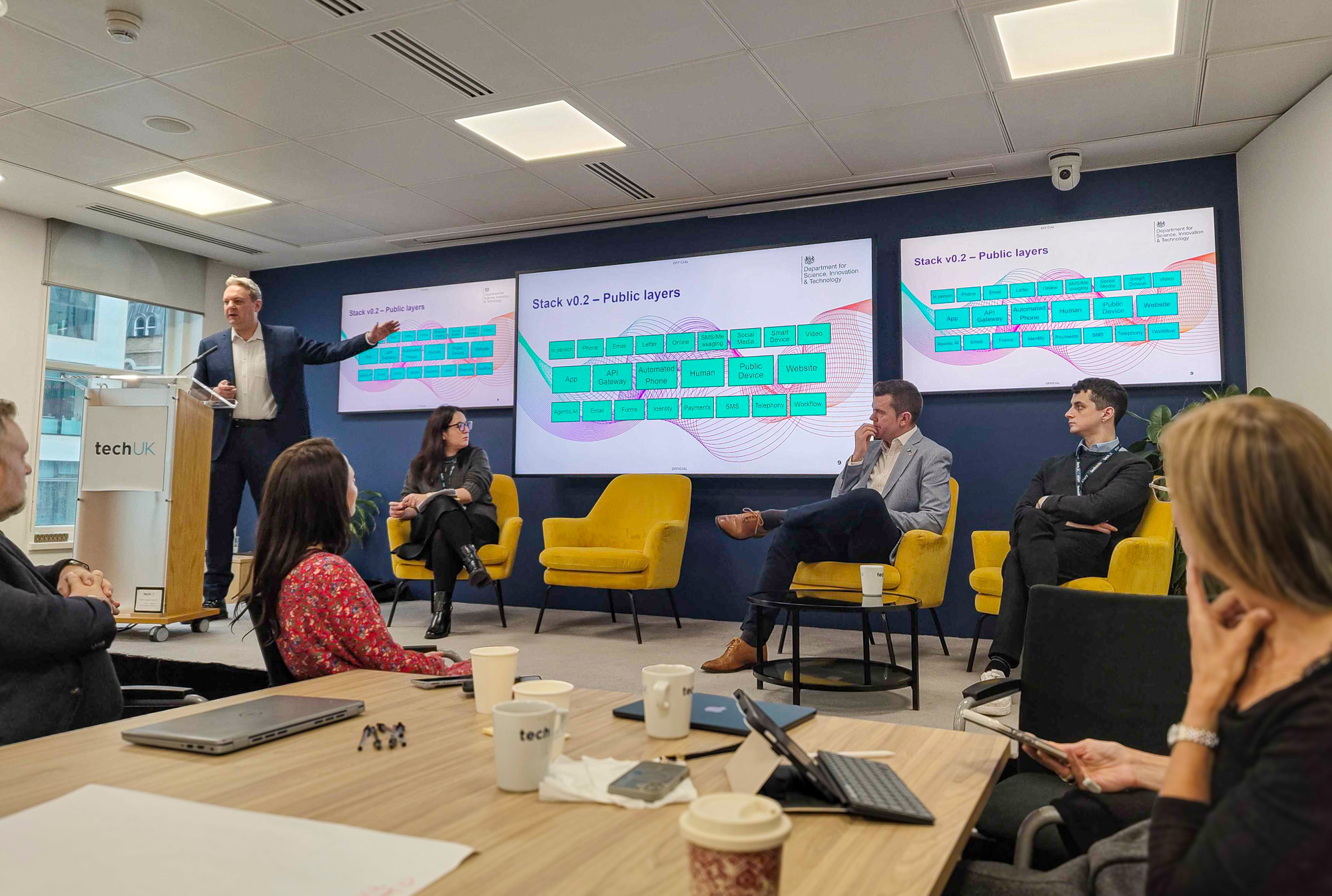
I was therefore over the moon to get to attend the (absolutely packed!) GDS Local Techstack Workshop, hosted by techUK and GDS Local. The session brought together suppliers, civil servants, and practitioners to help shape early thinking on a shared technical architecture. What follows are my reflections from the day, and a metaphor from Madeline Hoskin that stuck with me: the idea of farming a prairie, not planting neat rows.
Mapping Our Progress Towards a Modern Blueprint for Digital Government
Following a quick intro activity to get to know our roundtable team mates, complete with New Year’s resolutions like drinking more cocktails, swearing less, and mastering kickboxing (which gave us a vivid sense of what a night out together might involve!) – we got down to business.
We were asked to map our organisation’s current activities on a matrix of key themes (User Experience & Inclusion, Data & Interoperability, and Technology & Sustainability) against a maturity scale (Experimental, Emerging, or Standard Practice).
Unsurprisingly, AI dominated the experimental and emerging segments. However, there was a healthy emphasis on realism, focusing on AI as an accelerator for outcomes rather than a magic wand.
At Nimble Approach, we’ve seen a surge in work helping organisations get their services, data, and teams into a shape where AI can safely and responsibly accelerate outcomes. This might involve speeding up decision-making, improving personalisation, or reducing manual effort for stretched teams. We have found the application of AI is particularly powerful where the context/expertise required is low but the volume is high. For example, automating the marking of short-form prose responses and generating consistent, high-quality student feedback at scale – a high-volume, low-context task where AI can remove significant manual effort while keeping teachers firmly in control of outcomes.

What’s Really Frustrating Us All
Next, we were invited to “have a moan.” Yes, really. This candid, good-humoured discussion between suppliers and public sector colleagues surfaced 3 key themes on our table:
1. The policy-delivery disconnect: There is more that can be done to empower policy and delivery teams to collaborate more consistently and effectively to better reduce waste and deliver intended policy outcomes. We can learn from our European counterparts like Denmark, where it is legally mandatory for all new legislation to be screened against seven principles of digital-readiness, spanning: Simple and Clear Rules / Digital Communication / Automated Case Management / Consistency Through Uniform Concepts and Reuse / Safe and Secure Data Handling / Reuse of Public Infrastructure / Prevention of Fraud and Errors.
2. Procurement that stifles innovation: Current buying patterns favour broad, monolithic “digital partner” contracts. These are often designed in a way that smaller, innovative partners simply cannot compete for, as government buyers frequently lack the capacity or risk appetite for more granular procurements.
Our friends at Paper have highlighted that even with the new Procurement Act, we still have a long way to go. Drawing on their wider thinking after the event, we were reminded of the work of Mark Goddard, Co-Founder and Lead Service Designer at Paper. Although Mark wasn’t present at the roundtable, his work in this space has even led to direct engagement with his local MP, bringing the conversation about broken buying patterns into the political sphere.The reality is that under current models, SME ecosystems rarely see meaningful work flow down from “Prime” bids. More importantly, they are denied a seat at the table to speak directly to the client and bring their specialised thinking into the heart of government.
3. Siloed data remains a primary brake on innovation: Without interoperability, we are forced to design around organisational boundaries rather than user needs.
Rethinking Future Data Architecture
The workshop also explored what a future-ready data architecture might look like.
1. Connected, not collected
The prevailing assumption is often that interoperability requires a big, high-risk, monolithic data lake. But that doesn’t have to be the case.
The discussions at the workshop highlighted a vital shift in our thinking: moving away from collected data towards connected data. This replaces the concept of collecting data into unwieldy ‘data lakes,’ in favour of connecting data through live APIs and secure data flows. We see this already in the London Data Library, which uses a federated approach to join up the capital without hoarding data centrally. Similarly, the GDS Digital Wallet shows the power of verifying ‘attributes’ at the source rather than shuffling copies of documents between departments. This is how we break the silos, not by moving data into one big room, but by building the doorways that allow it to be shared safely and instantly when needed.
2. Is interoperability actually a human problem, not a technical one?
Once you accept that the technology largely exists and that the “connected vs. collected” model is already seeing success in projects like the London Data Library, the question inevitably shifts.
Is interoperability actually a human problem, not a technical one?
In her recent writing for Projects by IF, Sarah Gold argues that trust is not a soft outcome but a hard constraint. If we want to move toward a more joined-up government, we have to solve for trust on four levels:
- Trust between organisations: Do we feel safe sharing data across departmental boundaries?
- Trust to share risk: Who is accountable when a shared system fails?
- Trust from citizens: Are we being transparent enough for people to want their data reused?
- Trust in leadership: Who is governing these systems, and do they have the public’s best interests at heart?
If trust is the real bottleneck, then our biggest challenge isn’t the code; it is the communication. We need to explain these shifts in a way that feels safe and beneficial to the person on the street. As we explored in the workshop, creating a “shared architecture” is as much about building a shared social contract as it is about building APIs, and that is something GDS Local could really champion.

Celebrating the Diversity of Local Government
The workshop was a powerful reminder of the challenge GDS Local faces. To succeed, the team must navigate a national landscape defined by its diversity. It is not enough to simply “deliver” to local government; we must have the empathy to meaningfully cater to it.
Traditionally, we think about local government geographically. While this is the easiest mechanism for grouping, the discussions in the room suggested it may not be the most useful one. Geography does not account for the variables that actually dictate success and how local governments prioritise, such as the size of the community, existing vendor contracts, or budget pressures. A small rural council and a large metropolitan borough may be neighbours, yet they often have entirely different leadership capabilities, digital literacy levels, workforce skills, community priorities and budgets that dictate what success looks like to them.
If we want to build a truly national digital infrastructure, we cannot steamroller this diversity in the name of efficiency. Instead, we should celebrate and elevate it. This means moving away from the idea that standardisation requires everyone to look and act the same. Rather, we should build the common foundations that allow every council to flourish in its own way.
Conclusion: Farming a Prairie
Ultimately, the GDS Local Techstack Workshop showed that we are standing at a threshold. We have the technology, and we are starting to see “connected” data models emerge that can finally break the silos. Now, the real work begins on the human infrastructure: building trust, reforming procurement culture, and leading with empathy.
I keep coming back to a metaphor from Madeline Hoskin that resonated deeply during the day: the idea of farming a prairie, not planting neat rows. Madeline describes how we often try to force local government into uniform, “neat” categories that do not reflect reality. In contrast, she suggests that we should treat the sector like a prairie – a vast, diverse landscape where the goal is to create the right conditions for different ecosystems to thrive. To help a field of wildflowers grow, you do not divide it into identical squares; you group together areas that share similar conditions and tailor your care to what they actually need.
GDS Local represents this shift toward “farming the prairie.” It is about nurturing the soil, removing the barriers to growth, and allowing a diverse ecosystem of central and local partners to flourish together.
About the Author
Nina Midgley De-Jong has over 18 years’ experience working across digital agencies and consultancies, specialising in product, data, service design and GDS compliant digital delivery. Her career has focused on helping public sector and public-interest organisations design and deliver services that are practical, inclusive and user-centred.
She has led senior engagements supporting UK and European government teams, regulators and charities to improve how citizens interact with digital services. Her work spans discovery, design and delivery, with a strong emphasis on outcomes, governance and accessibility.